Before You Go, Let’s Talk About Your Parts
Tell us about your part, quantity, and key requirements. Nova Precision Manufacturing Co.,Ltd can help you choose suitable materials and manufacturing processes for your project.

Order chemically resistant, low-friction PTFE components for seals, gaskets, valve seats, bearings, bushings, liners, wear parts, and electrical insulation. Nova Precision Manufacturing Co.,Ltd supports CNC turning, milling, drilling, and routing from virgin and filled PTFE sheet, rod, tube, and molded stock.
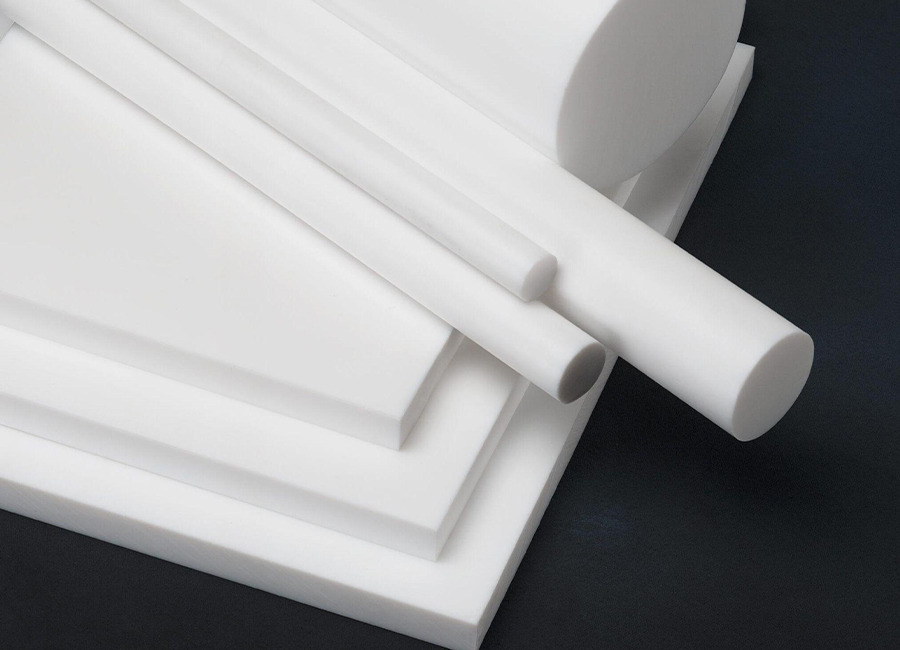
Polytetrafluoroethylene, or PTFE, combines very low friction, broad chemical resistance, high-temperature capability, electrical insulation, weather resistance, and negligible moisture absorption. It is widely used where ordinary plastics cannot tolerate the operating fluid, temperature, voltage, or sliding conditions.
PTFE is the generic material name. Teflon™ is a Chemours trademark covering branded fluoropolymer products. When genuine Teflon-branded resin is required, specify the exact grade and source. Otherwise, drawings should identify PTFE and the required material specification.
Unlike conventional melt-processable thermoplastics, standard PTFE is generally produced through compression molding, ram extrusion, paste extrusion, or related sintering processes. Custom precision parts are commonly CNC machined from previously molded or extruded sheet, rod, tube, and billet.
PTFE is relatively soft and has high thermal expansion, elastic recovery, and creep under sustained load. Clamping force, cutting heat, thin walls, inspection temperature, and the time between machining and measurement can all influence finished dimensions.
Unfilled PTFE provides the material’s strongest combination of chemical resistance, dielectric performance, purity, non-stick behavior, and low friction. It is commonly selected for gaskets, chemical seals, electrical insulators, laboratory components, liners, valve parts, and low-load bearings.
Request a QuoteGlass-filled PTFE improves wear resistance, compressive performance, and resistance to creep under load. It suits valve seats, seals, piston rings, bearings, and mechanical guides. Because glass can affect chemical compatibility and electrical properties, the filler percentage and operating fluid should be confirmed.
Carbon-filled PTFE can provide better wear performance, compressive strength, thermal conductivity, and dimensional stability than virgin material. It is used for bearings, bushings, seals, wear rings, and compressor components. Do not assume electrical conductivity or static dissipation without a specified and tested grade.
Bronze-filled PTFE offers high compressive strength, improved thermal conductivity, and good wear resistance for heavily loaded bearings, guide rings, hydraulic components, and piston applications. Its chemical resistance, electrical insulation, weight, color, and regulatory suitability differ substantially from virgin PTFE.
Project-specific options can include modified PTFE, food-contact grades, high-purity materials, detectable compounds, antistatic formulations, and specialty fillers. These are separate material systems. State the required regulation, purity level, electrical range, traceability, test method, and certificate before quotation.
Virgin, glass-filled, carbon-filled, bronze-filled, and modified PTFE are not direct substitutes. Fillers can improve creep, wear, or compressive performance while changing chemical resistance, dielectric behavior, purity, hardness, color, density, and machining response.
Provide the 3D model and 2D drawing with quantities, tolerances, service media, pressure, temperature, mating components, motion, expected life, and certificate requirements. We will review stock form, material allowance, clamping, cutting heat, burr control, staged machining, and practical inspection conditions.