Before You Go, Let’s Talk About Your Parts
Tell us about your part, quantity, and key requirements. Nova Precision Manufacturing Co.,Ltd can help you choose suitable materials and manufacturing processes for your project.

Source heat-resistant, dimensionally stable PEI components for electrical, aerospace, medical and industrial assemblies. Nova Precision Manufacturing Co.,Ltd provides CNC machining from PEI plate and rod, plus injection molding with unfilled, reinforced and application-qualified grades.
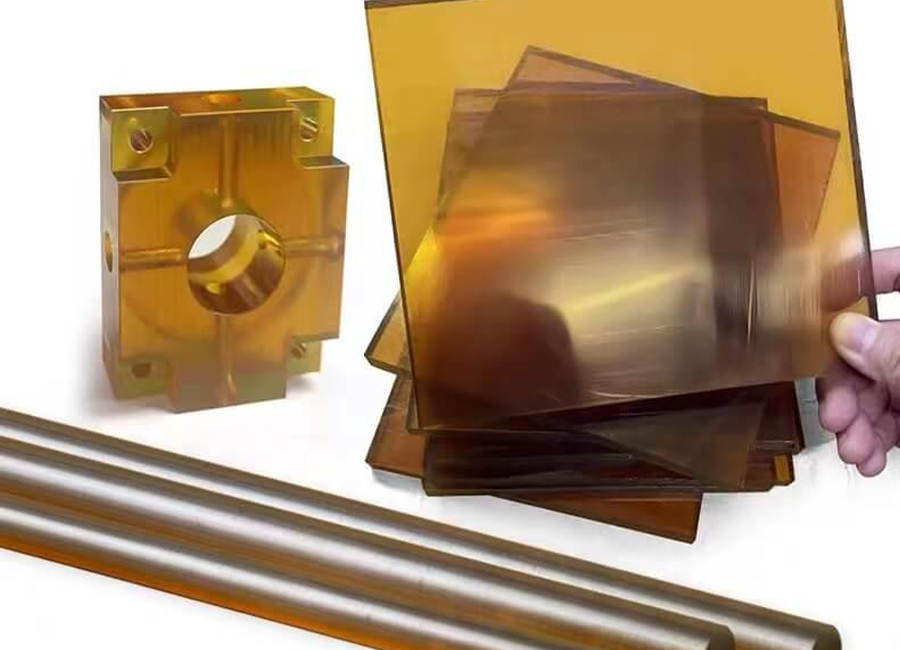
PEI is an amorphous high-performance thermoplastic commonly recognized by SABIC’s ULTEM brand. It combines elevated-temperature strength, dimensional stability, electrical insulation and inherent flame resistance in a lighter alternative to many metal components.
Its low creep and predictable dimensions support connectors, coil bobbins, insulators, semiconductor fixtures, aerospace brackets, medical instrument parts, HVAC components and high-temperature equipment housings.
Unfilled PEI and 30% glass-filled PEI can be CNC milled, turned and drilled for prototypes and lower-volume components. Injection molding supports repeated production, thin walls and integrated features such as ribs, bosses, clips and insert locations.
PEI is not one universal grade. Reinforcement, flow, color, flame performance, sterilization compatibility and regulatory status vary. Chemical exposure, impact loads and sharp stress concentrations must also be reviewed before material approval.
Unfilled PEI provides a balanced combination of heat resistance, mechanical strength, electrical insulation and inherent flame performance. Its natural translucent amber appearance is widely recognized in machined insulators, housings, brackets, manifolds and instrumentation components.
Discuss Unfilled PEIThirty-percent glass-filled PEI increases stiffness, tensile strength and dimensional stability under mechanical and thermal loading. It suits structural supports, connector bodies, aerospace components and precision fixtures. Fiber orientation, surface finish, impact and machining-tool wear require additional review.
High-flow PEI compounds are developed for injection-molded parts with thin walls, small features or longer flow paths. Typical applications include fiber-optic connectors, electrical terminals and compact electronic components where standard reinforced grades may be difficult to fill.
Healthcare PEI grades support medical-device housings, instrument handles, robotic components and reusable equipment. Selected materials offer biocompatibility documentation, controlled formulations and compatibility with steam, radiation or chemical sterilization methods. Requirements must be confirmed for the exact grade.
Qualified PEI grades are used in aircraft and transportation interiors because they combine low weight, heat resistance and controlled flame, smoke and toxicity performance. Applications include brackets, lighting parts, passenger-service components, trim supports and electrical housings.
Provide the following information for material and manufacturability review:
Names such as PEI, ULTEM 1000 and ULTEM 2300 do not represent interchangeable specifications. Glass reinforcement changes stiffness, thermal expansion, shrinkage, impact behavior, appearance and machining conditions.
For molded components, Nova reviews material drying, processing temperature, wall uniformity, gates, vents, weld lines, cooling and fiber orientation. Machined parts require suitable stock dimensions, controlled heat generation, stable workholding and support around thin walls or delicate features.