Before You Go, Let’s Talk About Your Parts
Tell us about your part, quantity, and key requirements. Nova Precision Manufacturing Co.,Ltd can help you choose suitable materials and manufacturing processes for your project.

Order rigid, dimensionally stable PET components for machinery, food equipment and electrical assemblies. Nova Precision Manufacturing Co.,Ltd machines semi-crystalline PET and PET-P stock while supporting injection molding with unfilled, reinforced and flame-rated compounds from prototype through repeat production.
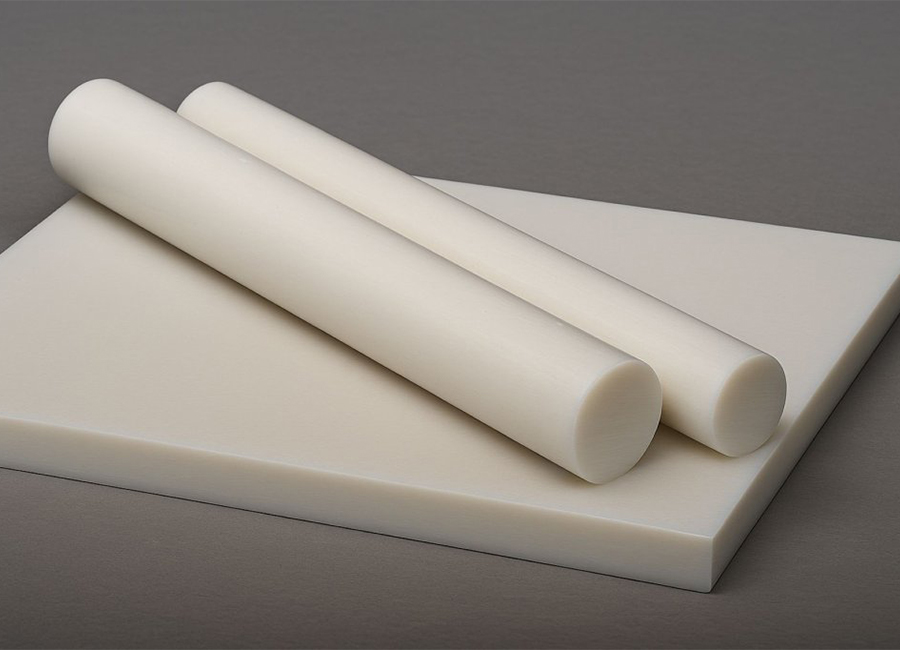
Engineering PET is different from the amorphous PET commonly used for clear bottles. Machined industrial components normally use semi-crystalline PET, often marketed as PET-P, which provides greater rigidity, wear performance and dimensional control.
Low moisture absorption helps finished parts maintain tolerances as humidity changes. Its combination of strength, hardness, creep resistance and low sliding friction suits guides, rollers, bushings, valve parts, gears, insulators and precision fixtures.
PET sheet, rod and tube can be milled, turned and drilled for prototypes, replacement parts and lower production volumes. Reinforced PET compounds can also be injection molded into housings, connectors and structural components with integrated ribs, bosses and fastening features.
Exact grade selection remains important. Hot water, steam, alkaline cleaners, impact loads, food contact and flame requirements must be checked separately. PETG and packaging-grade PET should not be automatically substituted for engineering PET-P.
Unfilled, semi-crystalline PET-P provides high rigidity, good creep resistance and consistent dimensions. It is a practical choice for guides, spacers, rollers, equipment brackets, valve components and electrical insulators produced from plate, rod or tube.
Discuss General-Purpose PET-PDocumented food-contact grades are used for guide rails, filling-equipment components, scrapers, rollers and packaging-machine parts. Approval depends on the exact manufacturer, grade, color and stock form, so declarations must be reviewed before production.
Internally lubricated or PTFE-modified PET reduces friction and improves sliding wear. These materials support bushings, bearings, thrust washers, slide blocks and guide components operating against metal or plastic mating surfaces, particularly where dimensional consistency and reduced noise matter.
Glass fibers increase stiffness, load capacity, creep resistance and dimensional stability. Reinforced PET is commonly injection molded into actuator housings, brackets, sensor bodies and structural electrical parts. Fiber orientation, weld lines, surface finish and warpage require early review.
Selected PET compounds combine reinforcement with documented flame performance for connectors, bobbins, switches, circuit-protection parts and electrical housings. Specify the required UL 94 classification, tested wall thickness, color and reinforcement level instead of requesting generic flame-resistant PET.
Provide the following information for material and manufacturability review:
Specifying “PET” alone leaves several decisions unresolved. Semi-crystalline PET-P, transparent amorphous PET, PETG and reinforced injection-molding compounds differ in stiffness, impact response, wear behavior, processing and temperature capability.
For CNC parts, Nova reviews stock direction, workholding, corner radii, heat control and the stability of thin sections. For injection-molded parts, we assess resin drying, mold temperature, crystallization, wall uniformity, gates, weld lines, fiber orientation and shrinkage.