Before You Go, Let’s Talk About Your Parts
Tell us about your part, quantity, and key requirements. Nova Precision Manufacturing Co.,Ltd can help you choose suitable materials and manufacturing processes for your project.

Order high-impact, heat-resistant PPSU components for sterilization trays, instrument handles, hot-water fittings, manifolds, connectors and demanding equipment assemblies. Nova Precision Manufacturing Co.,Ltd supports CNC milling, turning, drilling and injection molding in unfilled, medical, food-contact, glass-filled and application-specific PPSU grades.
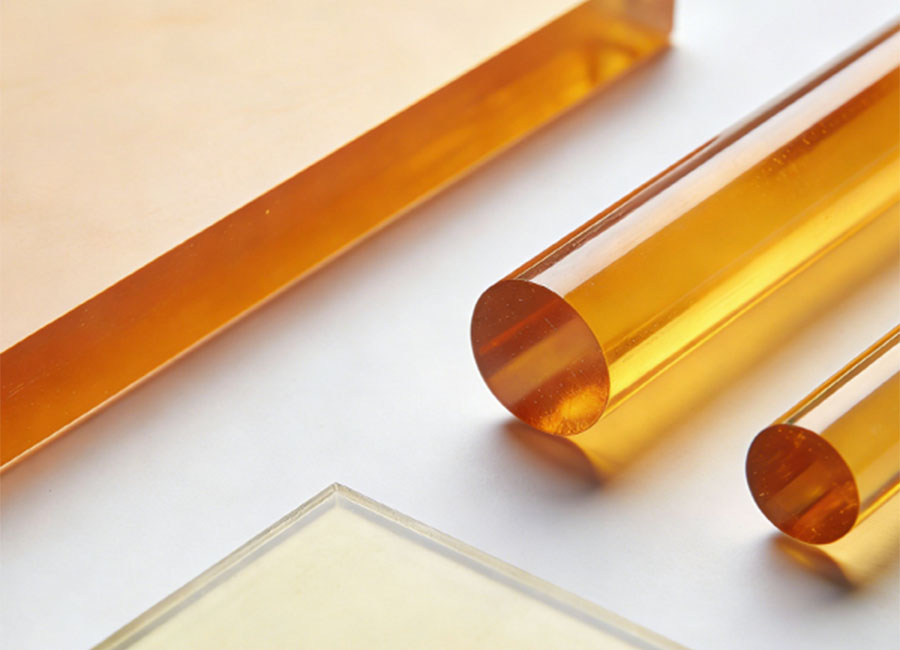
Polyphenylsulfone, commonly abbreviated as PPSU or PPSF, is an amorphous high-performance thermoplastic known for toughness, heat resistance and long-term hydrolytic stability. It maintains useful mechanical properties during repeated exposure to hot water, steam and demanding cleaning processes.
PPSU is used for reusable medical instruments, sterilization cases, fluid manifolds, valve components, hot-water fittings, electrical connectors, food-service equipment and aircraft interior parts. Natural PPSU normally has a transparent amber or honey-colored appearance, while opaque and colored grades are also available.
CNC machining from PPSU rod or plate supports prototypes, replacement parts and lower-volume production. Injection molding is suitable for repeat quantities and integrated geometries, but the resin requires thorough drying, high processing temperatures and carefully controlled tooling conditions.
Performance depends on the exact resin, stock shape, colorant and additive package. Medical, food-contact, drinking-water and aerospace approvals are grade-specific. Certain solvents and cleaning chemicals may also cause environmental stress cracking when combined with molded-in or machining stress.
Unfilled PPSU provides high impact strength, heat resistance, electrical insulation and resistance to hot water and steam. It is considered for manifolds, connectors, handles, housings, valve components and reusable equipment parts. Transparent amber, black and other color options depend on the selected resin and stock supplier.
Discuss Unfilled PPSUSelected medical-grade PPSU materials are tested for biocompatibility and repeated sterilization. Applications include surgical instrument handles, sterilization trays, orthopedic trial components and reusable medical equipment. ISO 10993, USP Class VI, color stability and sterilization data must be confirmed for the exact grade and finished-part requirements.
Food-contact PPSU is used for beverage equipment, catering components, hot-water fittings, valves and reusable containers exposed to heat and cleaning. FDA, EU, drinking-water or regional approvals are not universal across all PPSU products. Contact temperature, time, pressure and cleaning agents should be included in the material review.
Glass reinforcement can increase stiffness, dimensional stability and resistance to deformation under load. These grades may suit structural housings, supports, carriers and high-temperature components. Fibers can reduce impact performance and transparency, influence molding shrinkage and increase cutting-tool wear during machining.
Specialized PPSU grades are available for aircraft interiors, transportation equipment and electrical assemblies requiring controlled flame, smoke and toxicity performance. Compliance depends on the resin, color, part thickness and test method. Inherent flame resistance should not be treated as proof that every PPSU part meets an aviation or UL specification.
Steam resistance data should be evaluated together with cleaning chemicals, mechanical stress and component geometry. A material surviving repeated autoclave exposure as an unloaded test sample may behave differently as a pressurized fitting, snap feature, threaded component or highly stressed instrument handle.
For molded parts, resin drying, gate size, uniform walls, tool temperature and controlled cooling help reduce voids, sink and residual stress. Machined PPSU parts require sharp tooling, balanced material removal and suitable heat control. Coolants and cleaning agents should be reviewed because amorphous plastics can be sensitive to stress cracking.