Before You Go, Let’s Talk About Your Parts
Tell us about your part, quantity, and key requirements. Nova Precision Manufacturing Co.,Ltd can help you choose suitable materials and manufacturing processes for your project.

Source custom copper components for power distribution, thermal management, RF, and fluid systems—including busbars, terminals, contacts, heat spreaders, electrodes, and cooling parts. Nova Precision Manufacturing Co.,Ltd supports CNC machining, Swiss-type turning, stamping, sheet-metal fabrication, and secondary finishing in C101, C110, C145, and project-specific copper grades.
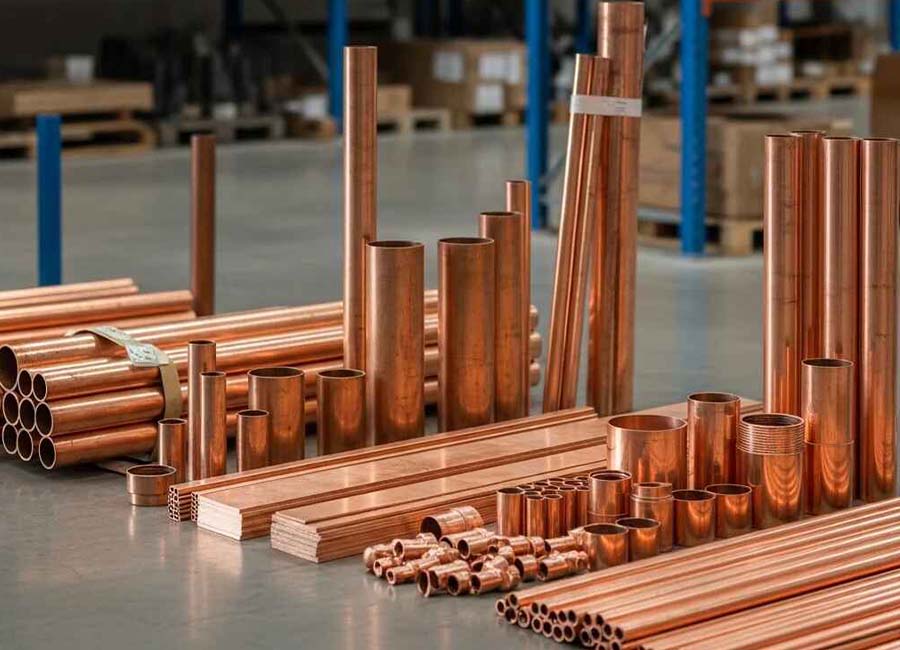
Copper is selected when current carrying, heat transfer, solderability, ductility, or corrosion behavior matters more than low weight or high cutting speed. It is widely used in electrical distribution, electronics, thermal management, RF equipment, industrial tooling, and fluid-handling assemblies.
Nova Precision manufactures copper components through CNC milling, turning, Swiss-type machining, drilling, stamping, bending, cutting, and secondary finishing. The production route is selected around the grade, stock form, geometry, quantity, joining method, and critical electrical or thermal interfaces.
Pure copper grades such as C101 and C110 are soft and ductile. During machining, they can produce long chips, built-up edges, smeared surfaces, and heavy burrs. C145 tellurium copper provides better chip control for complex turned or threaded components, while temper and stock condition can affect strength, flatness, and dimensional stability.
Available finishes can include as-machined, tumbled, brushed, polished, nickel-plated, tin-plated, silver-plated, or clear-coated surfaces. Bare copper gradually darkens when exposed to air, moisture, fingerprints, and chemicals, so functional contact areas, cosmetic surfaces, coating exclusions, and masking requirements should be identified on the drawing.
C101 is a very high-purity, very-low-oxygen copper selected when purity and performance in vacuum, electronic, or RF environments justify the additional material and machining cost. It is used for waveguides, cavity components, high-purity conductors, heat spreaders, and vacuum-system hardware. Its softness requires careful fixturing, chip evacuation, and burr control.
Request a QuoteC110 is the general-purpose ETP grade for busbars, ground straps, terminals, switchgear, conductive plates, heat sinks, and stamped electrical parts. It combines broad stock availability with useful forming, soldering, and conductivity performance. Brazing conditions, welding processes, and exposure to reducing atmospheres should be identified before material selection.
The tellurium addition gives C145 cleaner chip breaking and substantially better machinability than pure copper while retaining useful electrical and thermal performance. It is well suited to threaded connectors, contact pins, switchgear hardware, fasteners, torch tips, welding tips, and other turned parts where production speed and surface quality influence total cost.
C122 is phosphorus-deoxidized copper developed for forming, welding, brazing, and soldered assemblies. It is commonly considered for tubing, manifolds, heat-exchanger components, fluid hardware, and fabricated thermal parts. Residual phosphorus reduces electrical conductivity relative to C101 or C110, so it should not be substituted into a current-carrying design without engineering review.
C18150 is a precipitation-hardenable chromium-zirconium copper combining strength, wear resistance, and resistance to softening at elevated temperatures with useful conductivity. Applications include resistance-welding electrodes, electrode holders, mold inserts, high-load contacts, and thermal tooling. Its properties depend strongly on heat treatment and temper, so material condition and availability are confirmed for each RFQ.
C101 and C110 prioritize purity or conductivity but can be demanding to machine. C145 may reduce machining time for complex, threaded, or production-turned components. C122 fits formed and brazed thermal assemblies, while C18150 addresses parts requiring additional strength, wear resistance, or elevated-temperature stability. The highest-purity grade is not automatically the best option; the application and manufacturing route should determine the specification.
Provide the 3D model and controlled 2D drawing with quantity, material specification, temper, current or heat load, service temperature, mating contacts, joining method, flatness, coating, and inspection requirements. Our team will review workholding, chip evacuation, edge condition, distortion, contact masking, and coating buildup before quotation.