Before You Go, Let’s Talk About Your Parts
Tell us about your part, quantity, and key requirements. Nova Precision Manufacturing Co.,Ltd can help you choose suitable materials and manufacturing processes for your project.

How to choose between cast-in threads, cored-and-tapped holes, thread forming and CNC machining for die cast parts, and what to specify before requesting a quote.
For most internal threads in die cast housings and brackets, the practical choice is not “cast the thread” or “machine the thread.” It is a cored hole that is cast with the part and then finished by tapping, thread forming, or CNC machining. Truly cast-in internal threads need an unscrewing core and slow the casting cycle, so they are the exception. External threads, coarse threads, and single-turn features are the cases where casting the thread can make sense.
This guide explains where each route fits, how draft in a cored hole changes the thread you can get, and what to put on the drawing so the quote, the tooling, and the inspection all assume the same thing. Buyers sourcing parts from a die casting supplier can use it to decide which holes to leave to the die and which to machine.
Buyers and drawings use “cast-in” loosely, and the ambiguity causes quoting errors. There are four distinct routes:
A drawing that only says “M6 thread, cast” does not tell the die caster or the machine shop which of these is intended. The cost, the tolerance, and the failure risks differ for each.
Yes, but rarely, and usually not economically. The International Zinc Association’s die casting design rules state that most external threads can be cast if the parting line bisects them, while internal threads other than a single turn need an unscrewing core. The same guidance says forming internal threads in a secondary operation is usually more cost effective, because rotating the core to extract it slows the casting rate. Very coarse or steeply pitched threads are an exception because they release more easily.
That source covers zinc alloys. Aluminum and magnesium may behave differently in the die, so treat its conclusions as a strong signal rather than a rule for every alloy. The direction is still useful. An unscrewing core adds tooling complexity and cycle time, and the saving on a machining step usually does not cover that for a fine-pitch internal thread.
The same source also makes a structural point. Tapped bosses are stronger than cast threaded studs, because external threads create a notch effect under shock loading. If a design can use a tapped boss instead of a cast stud, it usually should.
The table below compares the routes qualitatively. It does not give cost figures, because real cost depends on thread size, quantity, alloy, and the machine shop.
| Route | Tooling impact | Best fit | Main risks | Verify with the supplier |
|---|---|---|---|---|
| Cast external thread (parting line bisects thread) | Thread profile cut into the die; needs high die accuracy | External threads where the parting line can bisect the thread and it is not a precision fit | Flash at the parting line; thread form limited by die condition | Parting-line position, whether light cleanup is acceptable |
| Cast internal thread (unscrewing core) | Rotating core mechanism; longer cycle | Coarse or single-turn threads in suitable volumes | Cycle time, tool complexity, core wear | Whether the added tooling cost is justified at your volume |
| Cored hole + cut tap | Core pin only; no drilling step | Standard internal threads where draft and thread fill are acceptable | Reduced thread fill at the large (open) end of the hole; tap breakage in blind holes | Thread fill percentage, chip clearance, hole depth |
| Cored hole + form tap or thread-forming screw | Core pin only; tighter hole control | Higher volumes, small diameters, chip-sensitive assemblies | Narrow window for hole diameter; poorer thread shape | Hole-size tolerance, screw or tap specification |
| Machined hole + tap or thread mill | No core needed, or an undersized core | Tight position, full-depth full threads, critical joints | Extra cycle and fixture cost; can expose porosity below the skin | Datums, machining allowance, inspection plan |
| Machined hole + thread insert | As above, plus insert installation | Repeated assembly, soft alloys, high-torque joints | Added part and installation step | Insert type, installation depth, pull-out requirement |
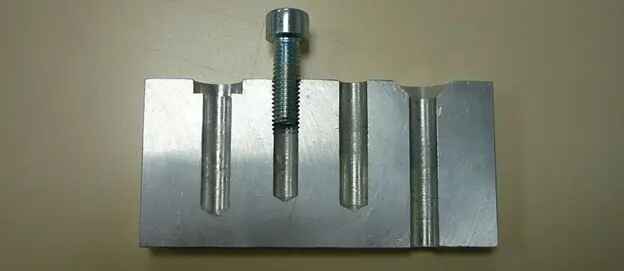
A cored hole is not parallel. Draft lets the core pin leave the casting, so the hole is larger at the open end than at the bottom. When a tap cuts into a tapered hole, the thread is fuller where the hole is small and shallower where it is large.
The zinc guidance gives a concrete reference point. If a full thread is not required, the hole can be cored to give about 60 percent of a full thread at the larger end and 75 percent at the other end. If a full thread is required, the taper should be machined out before tapping, or a much lower draft angle can be specified, depending on which is more cost-effective. The same source suggests keeping threaded depth to no more than twice the nominal screw diameter. It also suggests countersinking the hole about 2.5 mm larger than the thread to help tapping and assembly. These figures come from zinc-specific guidance, so confirm them with your die caster for aluminum or magnesium.
This is where the buyer’s drawing matters. A callout such as “M6 × 1-6H, 12 mm MIN FULL THREAD” tells the supplier what the joint needs. Nova’s guide to CNC thread design, depth, runout and inspection explains why a stated full-thread length is clearer than a nominal size alone. A cored hole with draft may give you 12 mm of thread, but not 12 mm of full-form thread. Decide which one the screw actually needs.
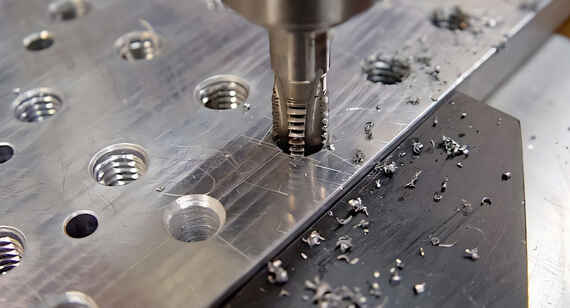
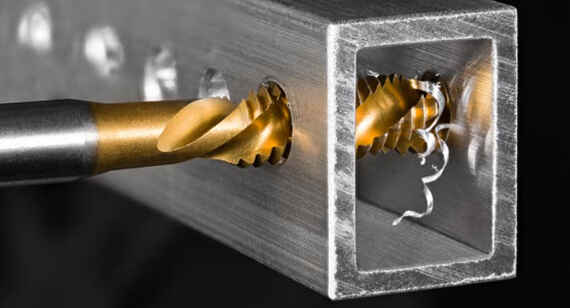
Once the hole is cored, the question becomes how to make the thread. A cut tap removes metal and produces chips. A form tap displaces metal and produces none.
According to the zinc industry’s tapping guidance, tapping is usually done on cored holes without any drilling operation. It describes form taps as fluteless and stronger than fluted cutting taps, which helps with small diameters where tap breakage is a risk. They leave no swarf, and thread strength is equal or better than a cut thread except for torque relaxation. The trade-offs are that form taps cost more, give a poorer thread shape, and need more accurate hole diameters. A roll-forming tap article from Cutting Tool Engineering supports the production-volume logic. It says form taps can offer longer tap life, lower cost per hole, and no chip handling in long runs and deep holes, while cutting taps may still suit short runs. That article dates from 1995, so it supports the principle rather than current tooling data.
The hole size is where the two methods diverge. The zinc source’s table lists a 5.050 mm parallel hole for a cut M6 thread and 5.490 mm for a rolled thread, a difference of about 0.44 mm. It also gives a formula for form-tap core diameter: basic tap diameter minus 0.772 × pitch × the percentage of thread required. For an M6 × 1 thread at 75 percent, that gives 5.421 mm, so the cored hole has to be controlled tightly. If the core pin wears or the hole shifts, a form tap is less forgiving.
Thread-forming screws that tap their own thread into a cored hole are a related option for assemblies that will not be repeatedly disassembled. Ask the fastener supplier for the recommended hole size, because it is specific to the screw and alloy.

Thread quality is only half of the hole’s job. The other half is where the axis ends up. Casting places a cored hole according to the die, and Nova’s manufacturing standards note that as-cast dimensions depend on alloy, wall thickness, part size, draft, die temperature, shrinkage, and feature location. The same page says critical fits, sealing faces, threaded holes, and tight datum relationships may need secondary CNC machining. It adds that this should be identified in both the as-cast model and the final part drawing.
A threaded hole that must align with a dowel, a bearing bore, or a mating housing is usually a machining candidate. Drilling and tapping the hole in the same CNC setup as the other critical features keeps its location tied to the machined datums. Nova’s CNC drilling service lists tapped holes, reaming, and boring as hole operations that can be combined, depending on the hole geometry and tolerance.
Diameter and position are separate requirements. As explained in hole position vs hole diameter tolerance in CNC drilling, a hole can pass a gauge check and still fail assembly if its location is wrong. That article also notes that applying bonus tolerance to threaded holes is hard to do. Confirm any material-condition callout on a threaded hole with the supplier before it goes on the drawing.
The conventional assumption is that casting a feature saves a machining step, so more cast detail means lower cost. For internal threads, the reasoning often fails. Rotating-core tooling adds complexity and slows every shot. The sensible saving is usually the middle route: a cored hole that removes the drilling step, with tapping done in a second operation.
The opposite assumption also deserves scrutiny: that machining every hole is safer. Machining adds fixtures, handling, and inspection, and it can expose porosity below the casting skin. Nova’s die casting page notes that critical parts can be checked by X-ray, CT, leak testing, or pressure-decay testing. Its standards page says porosity limits and leak testing should be reviewed before tooling begins. If the part must hold pressure, ask whether machined surfaces and threads are inside the leak-tested envelope.
Volume matters too. Nova’s page says die casting is generally most economical for repeat orders of several thousand parts or more, with the break-even depending on tooling and complexity. At prototype or low volumes, machining all the threads from a cast blank, or from solid stock, may cost less than tooling cores to a final thread specification.
Partial thread at the open end. Draft in a cored hole leaves a reduced thread at the large end, so the usable full-thread length may be shorter than the drawing assumes. Specify minimum full-thread length, not just hole depth.
Chip packing and tap breakage in blind holes. The zinc design guidance warns that tap and chip clearance must be allowed beyond the last thread, or a through hole must be provided. Form taps avoid chips but need tighter hole control.
Stripping in softer alloys. For joints that are tightened and removed repeatedly, or that carry high torque, the thread may need a helical or press-in insert. The required engagement depends on the alloy, screw strength, and loads, so it cannot be a fixed multiple on the drawing.
Coating changes thread fit. Plating, anodizing, and powder coat add thickness. State whether the thread class applies before or after finishing, and whether threads are to be masked. Nova’s thread design page lists surface treatment among the callout details that can affect thread fit.
Wrong inspection assumption. A GO/NO-GO thread gauge checks functional acceptance, but it does not map every thread element. If the joint is critical, say what must be measured and how. Nova’s standards page states that threads should be fully formed to the specified size and class, so say which thread checks are part of acceptance.
A quotation is only as reliable as the thread information supplied. For each threaded hole, define:
Nova’s design guides cover how to prepare CAD models and 2D drawings so that threads, datums, and inspection requirements are communicated clearly before a quote. Ask for a design-for-manufacturing review of the threaded holes before the die is cut. A core pin that is wrong in steel is far more expensive to change than a callout that is wrong on paper.
Yes, but usually only with an unscrewing core, which slows the cycle and adds tooling cost. Single-turn and very coarse threads are easier exceptions. Most buyers get a better cost result by coring a hole and tapping or thread-forming it afterward.
Not always. Zinc die casting guidance says tapping is usually done on cored holes without a drilling operation. If a full thread, tight location, or removal of draft is required, the hole may need to be machined before tapping.
It depends. Form taps leave no chips and are less prone to breakage in small diameters, but they cost more, give a poorer thread shape, and need more accurate hole diameters. Cut taps tolerate hole variation better. Test both on first-article parts.
Zinc guidance suggests keeping threaded depth to no more than twice the nominal screw diameter. The right depth depends on alloy, screw strength, and load. Specify minimum full-thread length and leave room below it for tap and chip clearance.
Tight thread class and location requirements generally point toward machining. Nova’s standards page says critical fits, threaded holes, and tight datum relationships may need secondary CNC machining. Identify those holes on the final drawing and the as-cast model.
It can. Machining removes the casting skin and can open subsurface porosity. If the part must hold pressure or carry high joint loads, discuss porosity limits, X-ray or CT inspection, and leak testing before tooling begins.
Consider an insert when the joint is assembled and disassembled repeatedly, uses a high-strength screw in a soft alloy, or carries high torque. Confirm the insert type, installation method, and pull-out requirement with the supplier.
