Before You Go, Let’s Talk About Your Parts
Tell us about your part, quantity, and key requirements. Nova Precision Manufacturing Co.,Ltd can help you choose suitable materials and manufacturing processes for your project.

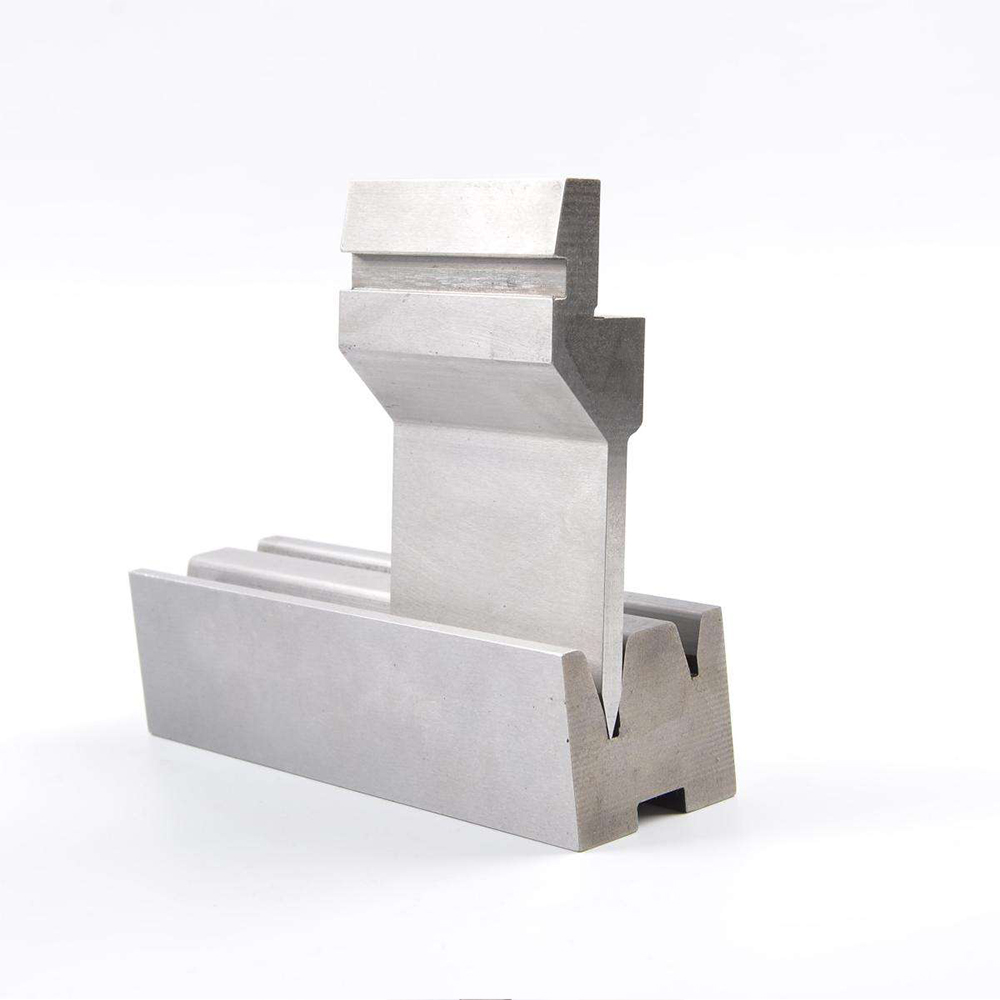
How to calculate when a stamping die costs less than laser cutting: the break-even formula, die cost drivers, a worked example, and what to specify before requesting quotes.
A stamping die turns a recurring per-part cost into a one-time tooling cost. Laser cutting needs no dedicated tool, but its price per part stays high. The break-even volume is the quantity at which the die’s up-front cost is paid back by the lower stamped piece price.
No single number applies to every part. Published rules of thumb range from a few thousand pieces to more than 50,000 per year, because die cost, the laser-route price and program stability differ so much between parts. This article shows how to calculate the crossover for your own part and which inputs move it most. It also covers how to avoid tooling too early or too late, and what to give a supplier so the quotes can be compared.
Break-even quantity = tooling cost ÷ savings per part. Savings per part is the current piece price minus the stamped piece price. Perry Tool & Die’s progressive die guide describes the same calculation and advises running it against the expected life of the program, not a single purchase order.
The formula is simple. The difficulty is choosing the right inputs.
Searching this topic returns thresholds that look contradictory. Fictiv’s progressive stamping guide says progressive tooling typically becomes viable at 50,000–100,000 units per year, and sometimes at 30,000–50,000 for very simple parts. DRAmetal puts the typical crossover between soft and hard tooling at 5,000–20,000 annual units, with the zone between those figures needing case-by-case judgment.
Both can be right, because they describe different situations:
A published threshold is a prompt to run your own numbers. It is not a result you can apply directly. The calculation below uses your part, not an average one.
Fictiv names three main drivers of progressive die cost: station count, material toughness and tolerance requirements. Each affects the quote differently.
Each cut, bend, form, coin or tap generally adds a station, which lengthens the die and raises build and tryout time. Strip layout also matters. The part must stay attached to a carrier strip until the final station, and that layout sets the strip width, feed pitch and material usage. Fictiv notes that progressive dies suit small-to-medium parts and relatively shallow profiles, while deep-drawn shapes usually go to transfer stamping.
Harder or more abrasive materials wear punches faster. Fictiv notes that stainless steel calls for more expensive tool steels or carbide in the die, which are harder to machine and maintain. Material thickness and coating also affect die clearances and wear life.
Tight tolerances add grinding and debugging during the build and shorten the interval between sharpenings. Fictiv notes that tolerances tighter than about ±0.05 mm require frequent sharpening, which raises cost. Tolerance applied to every dimension, not just the functional ones, is a common source of avoidable die cost.
Once the die steel is hardened, changes cost real money. Fictiv says a late-stage design change can cost as much as half the original tool price. DRAmetal gives much lower ranges for minor changes such as hole position. Either way, the lesson is the same: tool only when the design is frozen.
Published estimates for die build time vary. Fictiv cites 12–20 weeks for a high-quality progressive die, while DRAmetal cites 8–16 weeks. Your actual schedule depends on die complexity, tryout and the sample approval process. Lead time sets how long you keep paying laser-route prices or holding bridge inventory.
Laser cutting needs no hard tool, so its cost scales with machine time and handling:
Laser cutting suits prototypes, design revisions and mixed or low-volume orders. Buyers can review the laser cutting service to see how DXF profiles, edge requirements and secondary operations are handled. For cut-edge quality, Nova’s own standards page says laser-cut edges can show slight taper, vertical striations and lead-in or lead-out marks. Small holes, thick plate and heat-sensitive geometry need individual review.
| Factor | Laser cutting (plus brake forming) | Single-station or compound die | Progressive die |
|---|---|---|---|
| Dedicated tooling | None | Moderate | Highest |
| Cost of a design change | Low (reprogram) | Moderate to high | High, and can approach a large share of the die cost |
| Piece price trend with volume | Declines slowly | Declines meaningfully | Lowest at high volume |
| Best fit | Prototypes, revisions, low and mixed volume | Flat or simple parts at mid volume | Stable designs with high recurring volume |
| Main commercial risk | Paying a high unit price for years | Under-using a die that was cheap to build | Tooling for volume that never arrives |
| Edge characteristics | Laser striations, possible dross or heat tint | Die roll, burnished band and burr, controlled by clearance and maintenance | Same, but sharpening interval affects burr height |
| Key quality dependency | Nesting, heat input, edge specification | Die clearance and wear | Die maintenance, strip control, tryout approval |
This table is qualitative. Costs and thresholds depend on the part and on quotes from your suppliers.
This is an illustrative scenario with assumed numbers. It does not describe a real customer project or a quote from any supplier.
Assumptions: a 2 mm steel bracket with two bends and several holes.
Calculation:
Break-even moves substantially with die cost and savings per part:
| Total tooling cost | Savings $1.00/part | Savings $2.05/part | Savings $2.55/part |
|---|---|---|---|
| $20,000 | 20,000 | 9,756 | 7,843 |
| $34,000 | 34,000 | 16,585 | 13,333 |
| $60,000 | 60,000 | 29,268 | 23,529 |
(Hypothetical figures. Cells show break-even quantity in parts.)
The forecast then matters as much as the formula. Suppose the program is forecast at 6,000 parts a year for three years, or 18,000 parts. Net saving is 18,000 × $2.55 − $34,000 = $11,900. If actual volume falls 25% short, to 13,500 parts, the saving is about $425. In effect, the die only breaks even. This ignores the cost of capital, maintenance and any engineering changes, all of which would push the result negative.
Buyers often assume that once volume passes the break-even point, stamping is the right decision. That is not always the case. Break-even volume is a minimum, not a recommendation. Whether to tool depends on four conditions:
The reverse also applies. Staying on laser cutting after volume has clearly stabilized means paying a high unit price year after year. The right answer depends on the quality of your demand data, not only on the calculation.
When the volume is uncertain, a staged plan limits risk:
Nova’s metal stamping service page says stamping usually becomes more economical as repeat volume grows. It adds that laser-cut blanks, simple forming tools or temporary tooling may be recommended first when volume is low or the design may change.
To compare laser and stamping quotes fairly, give both suppliers the same information. A supplier can only run an honest break-even if it knows your real demand.
It depends on die cost and savings per part. Published vendor guidance ranges from a few thousand annual units for simple dies to 50,000+ for complex progressive tooling. Calculate it with your own quotes: tooling cost ÷ (laser price − stamped price).
Costs vary widely with station count, material, tolerance and part size. Published figures run from a few thousand dollars for simple tools to well over $100,000 for complex progressive dies. Ask for an itemized quote that includes tryout, spares and maintenance.
Usually, because it has no tooling cost. The exception is a part where one die operation replaces several costly secondary steps. If the savings per part are large, even a modest volume can justify simple tooling. Run the numbers.
Yes, and it is often the lowest-risk path. Validate demand and freeze the design on laser-cut and formed parts, then invest in a die. Have the supplier review the design for stamping before the switch, since some features change.
Check design engineering, tryout and first-article approval, spare punches and wear components, gauges, storage and scheduled refurbishment. Also ask how engineering changes are priced, since late changes can cost a large share of the original tool.
Published estimates range from about 8 to 20 weeks, depending on complexity, tryout and approval. Confirm the schedule with your supplier, and plan how parts will be supplied (for example from laser cutting) while the die is being built.
Customer-owned tooling gives the most freedom to move suppliers but requires paying the full cost up front. Supplier-owned or amortized tooling reduces cash outlay but ties the part to that supplier. Agree ownership, maintenance and release terms in writing before the die is built.
