Before You Go, Let’s Talk About Your Parts
Tell us about your part, quantity, and key requirements. Nova Precision Manufacturing Co.,Ltd can help you choose suitable materials and manufacturing processes for your project.

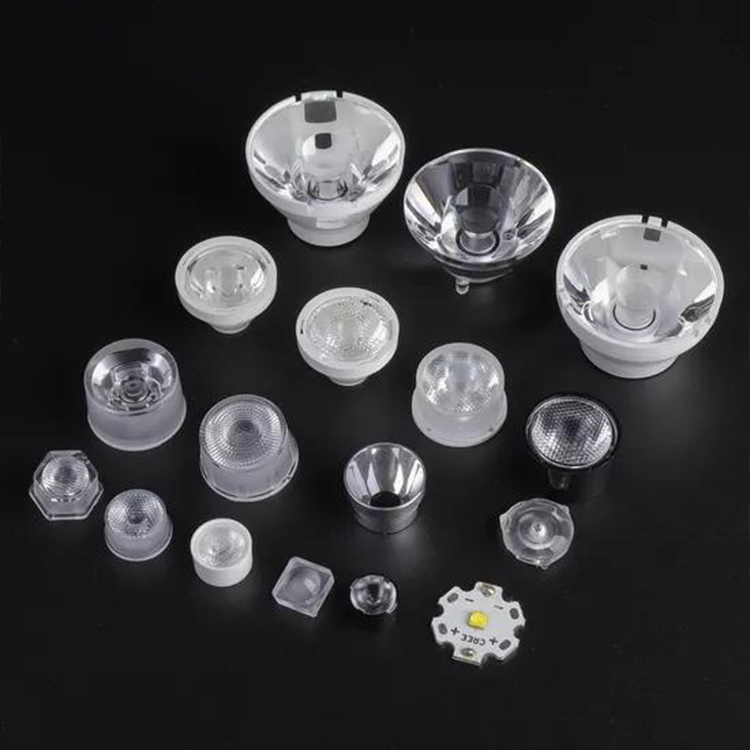
Acrylic and polycarbonate can both produce excellent LED diffusers, but they fail in different ways. This engineering comparison examines light transmission, haze, UV aging, impact resistance, thermal demands, and injection molding risks before you specify PMMA or PC.
Acrylic or polycarbonate?
That sounds simple.
It isn’t.
For an LED light diffuser, PMMA acrylic and polycarbonate can both produce attractive, uniform illumination, but the choice becomes much more complicated once you add optical transmission, diffuser concentration, impact loads, operating temperature, UV exposure, molded-in stress, flame requirements, wall thickness, and the actual geometry of the luminaire.
My working rule is straightforward: start with acrylic when optical efficiency, appearance, scratch resistance, and outdoor clarity dominate; start with polycarbonate when impact resistance, abuse tolerance, or higher-temperature performance dominates.
But don’t release a production drawing based on that sentence.
A diffuser is an optical system, not merely a plastic cover.
The first mistake I see in material comparisons is treating “clear plastic” and “diffusing plastic” as if they were the same specification.
They’re not.
A clear resin’s transmission tells us something about the optical losses inherent in the polymer, but a finished LED light diffuser molding intentionally scatters light. Diffusion particles, pigments, texture, wall thickness, surface finish, flow orientation, and part geometry can all change the finished optical result.
Still, the base-material numbers are revealing.
Research published through the University of Central Florida’s Florida Solar Energy Center reports the following representative values for standard acrylic and polycarbonate used as transparent lens materials: UCF material comparison
| Property | Acrylic / PMMA | Polycarbonate / PC | What It Means for an LED Diffuser |
|---|---|---|---|
| Visible transmittance | ~92% | ~86–89% | PMMA begins with a lower optical-loss penalty |
| Haze, clear material | ~2% | ~1–3% | Neither figure represents a formulated diffuser grade |
| Refractive index | ~1.49 | ~1.586 | Optical behavior and interface reflection differ |
| Surface behavior | Harder, better scratch resistance | Softer without coating | Relevant to exposed lenses and covers |
| Impact behavior | Lower toughness | Much higher toughness | PC makes sense where breakage is unacceptable |
| Weathering tendency | Generally stronger natural UV stability | Usually needs grade-specific UV protection outdoors | Important for exterior luminaires |
The Open University reports closely aligned refractive-index values—approximately 1.50 for PMMA and 1.59 for polycarbonate—which is useful confirmation that this difference is intrinsic to the material families rather than a marketing-sheet anomaly.
Here’s the trap, though: 92% clear-PMMA transmission does not mean your molded PMMA diffuser will transmit 92% of the luminaire’s light.
Once a manufacturer adds scattering particles to eliminate LED hot spots, transmission falls while haze rises. That’s intentional. A 90%-plus transmission number can be useless if individual LEDs remain visible.
Uniformity wins sometimes.
PMMA—poly(methyl methacrylate), commonly called acrylic—has a long history in lenses, light guides, illuminated signs, automotive lamps, and architectural lighting because it combines strong visible-light transmission with good surface quality and weather resistance.
Nova’s own acrylic material capabilities include molding-grade PMMA, specialty optical acrylic, light guides, diffusers, transparent covers, and lighting components. The distinction between cast sheet, extruded sheet, and molding-grade PMMA matters: they are not automatically interchangeable.
This matters more than many RFQs admit.
If an optical prototype was machined from clear cast PMMA and production will be injection molded from a diffusion-grade PMMA resin, approving the prototype does not automatically approve the production optical performance. Different resin, different flow history, different stress state, different surface replication.
Why assume they will look identical?
Polycarbonate’s argument is mechanical.
And it’s a strong one.
Research on PC/PMMA behavior describes BPA-based polycarbonate as having excellent mechanical toughness and heat resistance, while PMMA offers higher surface hardness, stronger scratch resistance, better weatherability, and lower birefringence. The same research reports representative refractive indices of about 1.57 for PC and 1.49 for PMMA.
If a diffuser can be hit, dropped, vandalized, flexed during assembly, snapped into a housing, or mounted where fragments would create a safety problem, optical efficiency is no longer the only priority.
That is where polycarbonate component design becomes relevant. Clear, UV-stabilized, optical, hard-coated, and flame-retardant PC grades can solve very different problems, and treating “polycarbonate” as one generic resin specification is asking for trouble.
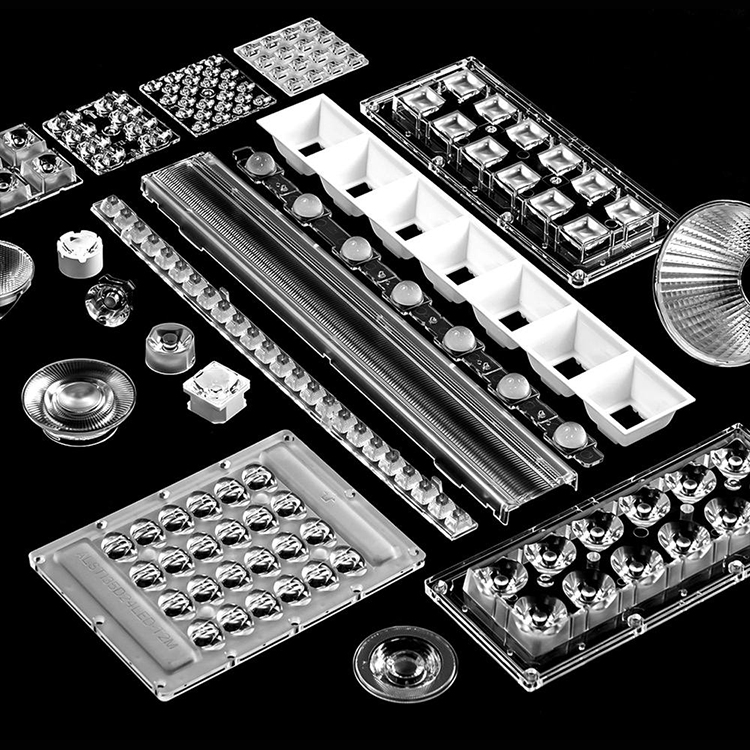
Here’s my least favorite specification:
“Material: white PC.”
That tells a molder almost nothing about the actual optical requirement.
Which transmission?
Which haze?
Which CCT shift?
Which diffusion level?
Which LED pitch?
Which wall thickness?
Which UV requirement?
Which flame rating?
Which cosmetic defect standard?
For a serious LED light diffuser, I would define optical performance at the finished-part level, not just name a polymer.
A diffuser has two competing jobs.
It must transmit light efficiently while scattering it strongly enough to hide the individual emitters.
More diffusion is not automatically better. Increase scattering too aggressively and fixture efficiency falls. Reduce it too far and the user sees bright LED dots through the cover.
So the useful question isn’t:
“Which material has the highest transmission?”
It is:
“Which material and diffusion package reach the required uniformity at the required fixture efficiency?”
That’s the engineering question.
For commercial lighting, I would want the supplier to know at minimum:
Nova’s lighting component manufacturing guidance similarly calls for transmission, haze, color, optical surface quality, UV exposure, and photometric requirements to be defined before optical components such as diffusers and light guides are quoted.
That is the correct approach.
Yellowing doesn’t happen on the purchase order.
It happens later.
And that’s precisely why it gets underestimated.
NIST conducted controlled accelerated-weathering experiments on engineering thermoplastics including polycarbonate, varying UV intensity, wavelength, temperature, and humidity. For the PC materials tested, the reported activation energy for yellowing was around 20 kJ/mol, and a 10°C increase in temperature corresponded to roughly a 20%–30% increase in degradation rate under the experiment’s conditions. NIST accelerated-weathering research
There is an important caveat: those particular NIST specimens contained 3% TiO₂ by mass, so I would not use the experiment to predict the exact service life of a transparent LED diffuser.
But the engineering message survives the caveat.
Heat matters.
UV matters.
And accelerated-aging results cannot casually be transferred from one resin formulation to another.
Plain PC and UV-stabilized PC are not the same purchasing specification.
For outdoor lighting, UV-stabilized grades, coextruded UV layers, hard coatings, or other protective systems may be needed depending on the required life and visual limits. The specific solution must be validated with the resin supplier’s aging data.
Acrylic begins from a different position. Standard PMMA is known for strong weatherability, which is one reason it remains common in exterior optical applications.
But even that statement needs qualification.
Impact-modified PMMA, high-temperature PMMA, diffusion-modified PMMA, standard transparent PMMA, and UV-filtering PMMA do not necessarily age or transmit light identically.
Grade beats acronym.
There’s also an industry assumption worth killing: “PMMA means low temperature; PC means high temperature.”
Too simplistic.
Röhm’s PLEXIGLAS® Optical HT, for example, carries a reported UL RTI continuous-use classification up to 105°C, specifically targeting optical applications requiring higher long-term temperatures. PLEXIGLAS Optical HT technical announcement
An even more concrete example is automotive lighting. Röhm reports that Magna Lighting uses the same Optical HT material for approximately 50 cm light guides in the Lancia Ypsilon’s front lighting system.
That’s why I dislike blanket material rules.
Specific grades move the boundary.
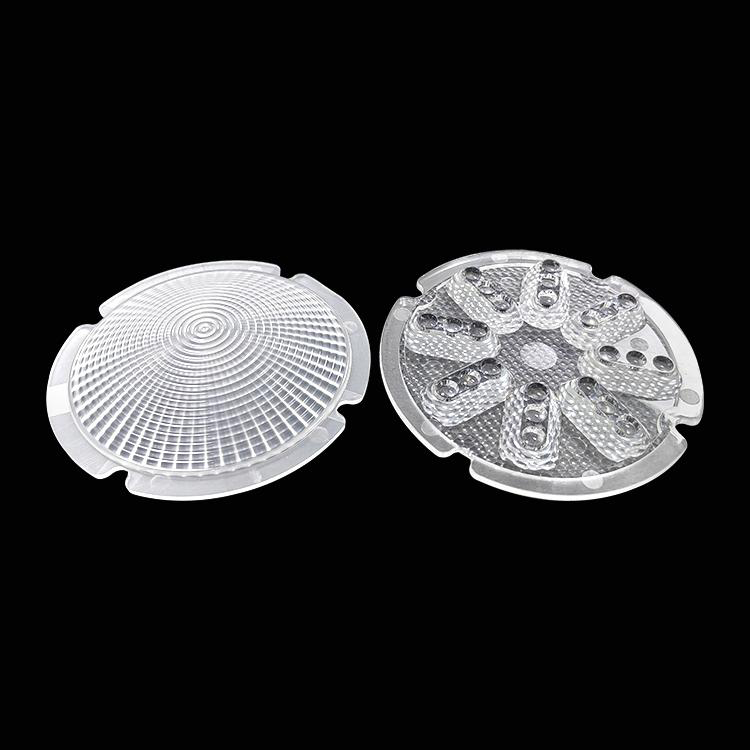
You can buy premium optical resin and still mold a mediocre diffuser.
Easily.
Injection molding introduces flow fronts, orientation, residual stress, weld lines, gate vestiges, sink, warpage, burn marks, bubbles, contamination, and surface-replication issues. On an internal structural component these may be manageable cosmetic defects.
On an illuminated diffuser, the LEDs expose them.
Every one.
Nova’s custom injection molding process highlights gate location, wall thickness, resin condition, drying requirements, temperature, fill and pack conditions, cooling, shrinkage, and internal stress as variables that need control during tooling and production.
A gate isn’t only there to fill the cavity.
The flow pattern it creates can influence cosmetic appearance, weld-line position, orientation, shrinkage, residual stress, and ultimately what the illuminated surface looks like.
So I would keep the gate away from high-visibility optical areas whenever geometry and filling requirements permit.
But moving a gate simply to hide it can create a worse fill pattern.
That’s why the tooling engineer and optical engineer need to speak before steel is cut.
Large wall-thickness transitions invite uneven cooling and shrinkage.
For a diffuser, the problem goes beyond warpage. Different material thickness means a different optical path length, which can create visible brightness variation even when the diffusion compound itself is perfectly consistent.
This is where manufacturability and photometry collide.
And sometimes the “beautiful” CAD model is the problem.
Both PMMA and polycarbonate require grade-specific processing discipline, and moisture control becomes especially important for optical parts.
The correct drying temperature and time should come from the exact resin manufacturer’s processing sheet—not from a generic internet table or the settings left in the hopper dryer from yesterday’s production.
My rule would be uncompromising: record the resin lot, dryer conditions, molding parameters, and approved golden sample for any diffuser whose appearance matters.
Otherwise troubleshooting becomes archaeology.
For most projects, I would narrow the decision this way.
Optical efficiency is heavily weighted.
PMMA deserves serious consideration for indoor architectural fixtures, decorative lighting, linear luminaires, illuminated signage, display lighting, light guides, automotive lighting, and outdoor fixtures where weatherability and long-term appearance matter more than extreme impact strength.
Its strong base transmission gives the optical designer more room to trade some efficiency for diffusion.
Mechanical survival matters more.
PC is often the stronger candidate for public-space fixtures, industrial luminaires, portable products, transportation applications, protective covers, vandal-resistant lighting, snap-fit assemblies, or products requiring specialized flame-retardant material.
SABIC, for example, lists LEXAN™ injection-molding grades specifically for applications including LEDs, diffusers, traffic lights, spotlights, reflectors, lamp holders, and emergency lights.
That’s not accidental.
PC’s toughness solves real product failures.
This is the part procurement teams sometimes hate.
You need samples.
Not just resin plaques.
Not just a pretty rendering.
Actual molded parts.
For a meaningful PMMA-versus-PC comparison, build or sample parts at the intended wall thickness, diffusion level, surface finish, gate strategy, and LED spacing. Then measure total transmission, haze, photometric distribution, color shift, hot spots, thermal aging, UV aging where applicable, impact performance, and dimensional stability.
The cheapest resin on the quote sheet can become the expensive resin after a mold revision.
I would divide validation into four gates.
Measure the diffuser in the actual luminaire or an optically representative fixture.
Check luminous output, uniformity, LED imaging, beam distribution, glare, CCT shift, and color consistency.
Test the assembled part rather than assuming resin-property data predicts product behavior.
Snap features, screw bosses, clips, transport shock, drops, cleaning, handling, and installation loads can generate stress concentrations that a flat resin test plaque never experiences.
Replicate the expected temperature, UV, humidity, chemicals, cleaners, dust, and duty cycle.
Remember the NIST result: temperature materially changes polymer-degradation kinetics.
Do not qualify an outdoor diffuser using a one-week indoor bench test.
Approve more than one good-looking T1 sample.
Check multiple cavities if the mold is multi-cavity. Check different positions within a production run. Track resin lot, molding conditions, dimensions, color, optical output, and visible defects.
Then establish an approved golden sample.
That’s boring manufacturing work.
It’s also where reliable products come from.
Acrylic is generally the stronger LED light diffuser choice when high light transmission, weatherability, surface hardness, optical appearance, and efficiency are the main requirements, while polycarbonate is generally preferred when impact resistance, tougher assembly behavior, higher thermal margin, or specialized flame-rated grades matter more than maximum base-material transmission.
The final decision should be made using the actual diffusion grade and finished molded geometry. Clear standard PMMA can reach roughly 92% visible transmittance, while representative clear polycarbonate values are around 86%–89%, but a real diffuser intentionally sacrifices some transmission to scatter light.
A polycarbonate LED diffuser is usually appropriate when the molded cover may experience impacts, vandalism, drops, flexing, aggressive snap-fit assembly, elevated temperatures, or product-safety requirements that justify sacrificing some optical transmission and surface hardness in exchange for the substantially tougher mechanical behavior available from suitable PC grades.
For outdoor use, specify UV performance rather than simply writing “PC” on the drawing. UV-stabilized, optical, coated, and flame-retardant polycarbonate grades can behave very differently.
Injection molding can reduce LED diffuser optical performance when gate placement, moisture, melt temperature, packing, wall thickness, cooling, surface finish, contamination, residual stress, weld lines, or shrinkage create optical non-uniformity, even when the PMMA or polycarbonate resin itself meets the manufacturer’s nominal transmission and haze specifications before molding.
That is why an optical diffuser should be approved as a finished molded component. Tooling and processing variables must be considered part of the optical design, not treated as separate factory details.
Yellowing is best controlled by selecting a resin grade and stabilization package designed for the fixture’s actual UV spectrum, operating temperature, outdoor exposure, and service-life target, then validating the molded component through appropriate accelerated aging rather than assuming that standard acrylic or standard polycarbonate will remain optically unchanged indefinitely.
NIST testing demonstrates why temperature cannot be ignored: under its experimental conditions, increasing temperature by 10°C increased degradation rates by roughly 20%–30% for the polymers studied.
PMMA, or poly(methyl methacrylate), is the polymer commonly sold as acrylic, but an LED diffuser specification must go beyond the word PMMA because cast sheet, extruded sheet, injection-molding resin, impact-modified acrylic, high-temperature optical PMMA, and diffusion-modified compounds can have different processing behavior and finished optical performance.
For a molded diffuser, specify the exact resin grade or an approved equivalent along with transmission, haze, color, UV, thermal, dimensional, and cosmetic requirements.
Don’t choose an acrylic LED diffuser or polycarbonate LED diffuser from a generic material chart.
Choose it from the application.
Define transmission. Define diffusion. Define wall thickness. Define operating temperature and UV exposure. Define how much impact the product must survive. And most importantly, test the diffuser over the actual LEDs it will cover.
If you are preparing an LED light diffuser molding project, send the 3D CAD model, 2D drawing, expected production quantity, candidate PMMA or PC grade, LED spacing, optical targets, surface requirements, and operating environment for a manufacturability review.
Use Nova’s lighting-component and injection-molding resources to evaluate the optical part before tooling decisions become expensive.
The resin matters.
The molded part matters more.
