Before You Go, Let’s Talk About Your Parts
Tell us about your part, quantity, and key requirements. Nova Precision Manufacturing Co.,Ltd can help you choose suitable materials and manufacturing processes for your project.

Order low-friction, wear-resistant UHMW components for conveyor systems, chain guides, chute liners, wear strips, rollers, bushings, star wheels and food-processing equipment. Nova Precision Manufacturing Co.,Ltd provides CNC milling, turning, drilling, routing and fabrication from pressed or extruded UHMW sheet, plate, rod and profile.
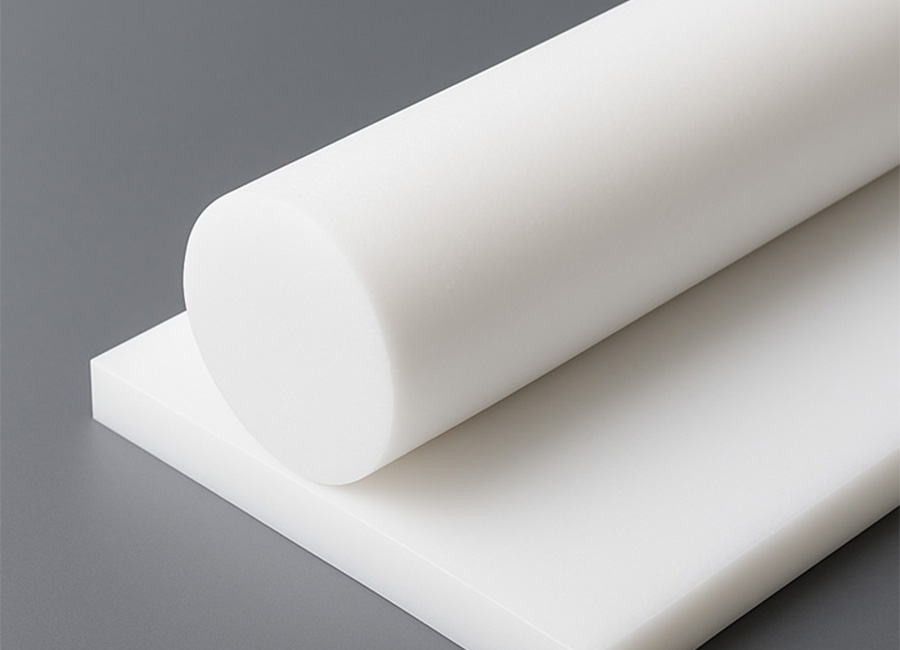
Ultra-high-molecular-weight polyethylene, commonly called UHMW, UHMW-PE or PE1000, has extremely long molecular chains. This structure gives the material high impact strength, strong abrasion resistance, low friction and minimal moisture absorption.
UHMW is frequently used where parts slide against chains, packages, bulk materials or metal surfaces. Applications include conveyor rails, guide profiles, sprockets, wear pads, hopper liners, scraper blades, rollers, bearings, dock fenders and replaceable machine components.
Most custom UHMW parts are machined from compression-molded sheet or ram-extruded rod and profile. Its exceptionally high melt viscosity makes standard UHMW unsuitable for conventional injection molding. Specialized moldable formulations exist, but they should not be assumed equivalent to traditional PE1000 stock.
UHMW is softer and less dimensionally stable than POM, PET or metal. It can creep under sustained load and expands noticeably as temperature changes. Successful part design therefore requires suitable clearances, support, fastening and realistic tolerance requirements.
Virgin UHMW provides a consistent balance of impact strength, wear resistance, chemical resistance and low friction. It is widely used for chain guides, wear strips, rollers, bushings and conveyor components. Natural, black and colored versions are available, subject to stock size and supplier specifications.
Discuss Virgin UHMW PartsReprocessed UHMW provides a cost-effective option for large wear pads, liners, guides and non-cosmetic industrial components. Color, surface and mechanical consistency may differ from virgin material. It should not be specified for food contact, regulated applications or tightly controlled performance unless supporting documentation is available.
Oil-filled UHMW contains a dispersed lubricant that further reduces friction and can improve wear performance in conveying applications. It is considered for high-speed chain guides, bearing surfaces, seals and equipment where external lubrication is undesirable. Additive package, color and compliance must be checked by grade.
Antistatic, static-dissipative and conductive UHMW grades help control charge generated by moving powders, packages or conveyor components. They may be used in bulk handling, electronics and automated equipment. These electrical classifications are not interchangeable, so the required surface-resistance range must be defined.
Selected UHMW grades support FDA, EU or other food-contact requirements. Blue metal- or X-ray-detectable formulations are available for components where fragments must be identified by inspection equipment. Food-contact approval and detectability are separate requirements and must be verified for the exact grade and color.
Wear performance depends on the complete operating system rather than the plastic alone. Pressure, speed, generated heat, abrasive contamination, alignment and the mating material all influence service life. Modified UHMW may be needed when standard PE1000 cannot provide the required pressure-velocity or static-control performance.
During machining, UHMW can flex under cutting and clamping forces, while heat may affect size and surface quality. Sharp tools, adequate support and controlled material removal help manage stringy chips and distortion. Because UHMW is difficult to bond, mechanical fasteners, countersunk washers, slotted holes or plastic welding may be more suitable.